

Adjectives Word Order
GO HERE FOR MY ESL SONGS AND WORKSHEETS
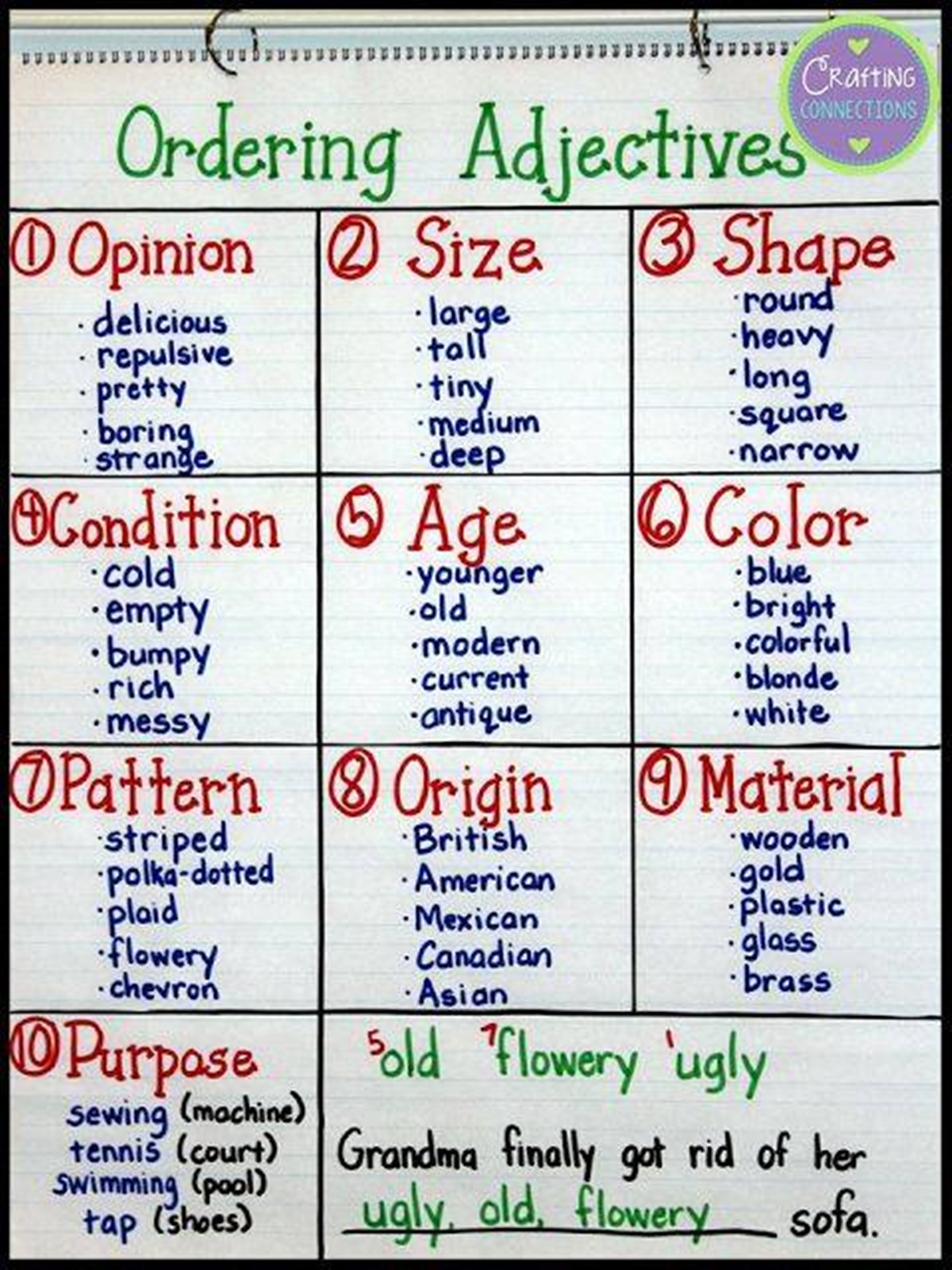
Adjective Word Order OSASCOMP
English adjectives follow a very specific order. Native speakers use it naturally, but learners often struggle because many languages allow flexible order. The good news: there is a simple pattern students can learn.
⭐ The Golden Rule:
Opinion → Size → Age → Shape → Color → Origin → Material → Purpose + Noun
A helpful memory trick:
OSASCOMP
(O-pinion, S-ize, A-ge, S-hape, C-olor, O-rigin, M-aterial, P-urpose)
📘 Adjective Word Order OSASCOMP Breakdown
| Category | Example |
|---|---|
| Opinion | beautiful, cute, expensive |
| Size | small, big, tiny |
| Age | old, young, new |
| Shape | round, square, long |
| Color | red, blue, green |
| Origin | Korean, Mexican, Italian |
| Material | wooden, plastic, metal |
| Purpose | sleeping (bag), running (shoes), cooking (pot) |
GO HERE FOR MY ESL SONGS AND WORKSHEETS
🧩 How It Works in Real Sentences
-
a beautiful small old wooden box
(opinion → size → age → material → noun) -
big round blue balloons
(size → shape → color → noun) -
an expensive Italian leather handbag
(opinion → origin → material → noun)
Students often ask:
“Can we change the order?”
Usually no—changing the order sounds unnatural.
🎯 Teaching Tips
1. Start with two adjectives first
Example:
-
a big dog
-
a big brown dog
Then add more.
2. Use color as an anchor
Most students can easily identify color adjectives.
Build from there.
3. Use sorting cards
Give students adjective cards and have them arrange them into correct order before placing them next to a noun card.
4. Compare correct and incorrect examples
Students love spotting mistakes.
🗣️ Model Sentences for Learners
Repeat and practice:
-
“I bought a nice black leather jacket.”
-
“She has a cute small brown dog.”
-
“We stayed in a beautiful old French hotel.”
————————————————————————–
🎯 Lesson Plan Adjectives Word Order OSASCOMP
Objectives
By the end of the lesson, students will be able to:
- Understand the standard order of English adjectives
- Use OSASCOMP to organize adjectives correctly
- Produce phrases and sentences with correct adjective order
👩🏫 Level
Intermediate ESL
🕒 Duration
45–60 minutes
🧰 Materials
- Worksheet (included below)
- Flashcards (included below)
- Whiteboard or screen
GO HERE FOR MY ESL SONGS AND WORKSHEETS
🧭 Procedure
1. Warm-Up (5 minutes)
Show students a noun (e.g., dog). Ask: “What kind of dog?” Let them call out random adjectives. Write them in random order, then correct to show proper order.
2. Teach OSASCOMP (10 minutes)
Explain the pattern: Opinion → Size → Age → Shape → Color → Origin → Material → Purpose + Noun Give examples. Have students repeat.
3. Guided Practice (10 minutes)
Write mixed adjective strings on the board and have students reorder them.
4. Pair Sorting Activity (10 minutes)
Use the flashcards. Students arrange adjectives into correct order before adding the noun.
5. Production (10 minutes)
Students write three adjective+noun phrases and share with a partner.
6. Review & Check (5 minutes)
Quickboard race: Teacher says adjectives, groups write correct order.
📄 WORKSHEET: Adjective Word Order Practice
Part A: Put the adjectives in the correct order.
- (Italian / beautiful / old / wooden / small) box → ______________________________
- (red / big) balloon → ______________________________
- (sleeping / large / new) bag → ______________________________
- (round / black / cute / little) cat → ______________________________
- (metal / modern / square) table → ______________________________
Part B: Choose the correct option.
- She bought a (blue small / small blue) notebook.
- We visited a (French old / old French) village.
- He has an (American leather / leather American) belt.
- I adopted a (brown tiny / tiny brown) rabbit.
- They stayed in a (lovely big / big lovely) house.
Part C: Create your own.
Write 3 noun phrases using 3–5 adjectives in correct order.
🃏 FLASHCARDS: Adjectives by Category
(Cut and shuffle.)
Opinion
- beautiful
- lovely
- horrible
- expensive
- cute
Size
- big
- small
- tiny
- huge
- large
Age
- new
- old
- ancient
- young
- modern
Shape
- round
- square
- long
- short
- wide
Color
- red
- blue
- green
- black
- yellow
Origin
- Italian
- Korean
- Mexican
- French
- Australian
Material
- wooden
- metal
- plastic
- leather
- cotton
Purpose
- sleeping (bag)
- running (shoes)
- cooking (pot)
- cleaning (cloth)
- writing (desk)
Answer Key – Adjective Word Order
Part A – Put the adjectives in the correct order
-
a beautiful big old house
-
a tiny round wooden table
-
a stylish black leather jacket
-
a delicious hot Italian meal
-
a cute small brown puppy
-
a wide modern glass window
-
a strange long metal object
-
a lovely young Australian couple
-
an expensive new silver laptop
-
a boring long history lecture
Part B – Rewrite the sentences correctly
-
She bought a beautiful long red dress.
-
They live in a modern tall grey building.
-
He adopted a small shy white cat.
-
We walked through a dark old narrow street.
-
She wore a huge bright yellow hat.
Part C – Choose the correct option
-
b. a small green plastic bowl
-
a. a nice warm Italian soup
-
c. a big old brown horse
-
a. a fun little weekend trip
-
b. a strange long metal tool
Part D – Create your own phrases (answers will vary)
Accept any that follow the adjective order pattern:
Opinion → Size → Age → Shape → Color → Origin → Material → Noun
Example acceptable answers:
-
a beautiful small new white Japanese car
-
a comfortable big old brown leather sofa
-
a delicious warm homemade chocolate cake
-
a cute tiny young grey kitten
-
an ugly huge ancient dark stone statue